
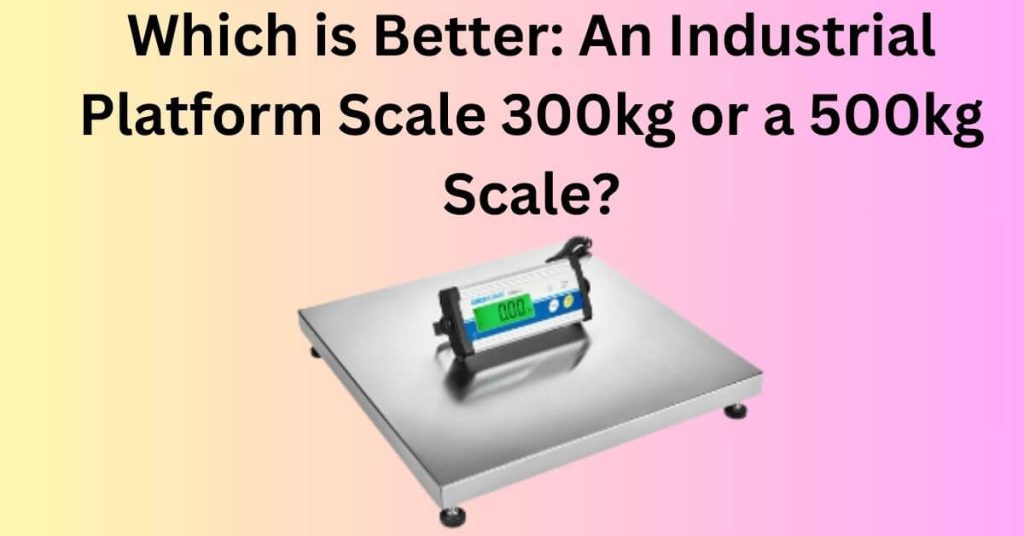
When you’re in the market for an industrial platform scale, it’s essential to select the right one that matches your operational requirements. The choice between a 300kg industrial platform scale and a 500kg industrial platform scale can be tricky, as both have their advantages depending on the specifics of your industry and how you intend to use them. In this article, we will delve into the key differences between these two types of scales and help you determine which one is the better fit for your business needs.
Key Aspects to Consider
When comparing a 300kg and a 500kg industrial platform scale, several factors come into play. Here’s a breakdown of these factors to guide your decision:
1. Capacity and Usage
Weight Capacity
The most significant difference between a 300kg and a 500kg scale is their maximum weight capacity. As the names suggest, a 300kg scale is designed to handle weights up to 300 kilograms, while a 500kg scale is capable of weighing up to 500 kilograms. If your business deals with heavier items on a regular basis, such as in construction, manufacturing, or logistics, a 500kg platform scale would be the more appropriate choice.
- 300kg scale: Ideal for businesses dealing with smaller, lighter loads. Think small packages, products in retail, or lightweight warehouse applications.
- 500kg scale: Best suited for industries that handle larger loads, like bulk materials, large shipping containers, or heavier machinery parts.
Application Suitability
- If your daily operations involve weighing items that often exceed 300kg, you’ll need the 500kg scale to ensure accuracy and avoid overloading the platform. Operating a 300kg scale with items close to its maximum capacity may cause strain on the scale, leading to inaccurate measurements or damage over time.
- If your operations are centered around smaller packages or products, the 300kg scale may be sufficient and more cost-effective.
2. Accuracy and Precision
Both scales typically provide high precision, but the degree of accuracy might vary depending on the model. When choosing between the two, you should check the readability of the scale.
- 300kg scale: These scales typically have a readability of 100g (0.1kg), which is suitable for most smaller operations where fine measurements are not as crucial.
- 500kg scale: The accuracy of a 500kg scale may vary, but many of these scales also offer a readability of 100g, making them just as precise as 300kg scales, even for heavier loads.
While both scales are capable of providing precise measurements, scale specifications should be consulted for exact details on the resolution.
3. Portability and Size
Physical Dimensions
A 500kg industrial platform scale is often larger than a 300kg scale due to its greater weight capacity. This means you may need additional space for placement, particularly if your workspace is limited.
- 300kg scale: Typically more compact, making it easier to fit into tight spaces or smaller warehouses.
- 500kg scale: Larger and bulkier, but designed to accommodate heavier, larger objects. The increased platform size provides the room necessary for handling bigger loads.
Weight of Scale
The weight of the scale itself can also impact portability. Heavier scales might be more challenging to move, especially in environments where frequent relocation is required.
- 300kg scale: Lighter, typically more portable, and easier to move around, especially in smaller work environments.
- 500kg scale: Heavier and less portable, but it’s designed to support larger and heavier loads, which makes it ideal for applications that require significant weight tolerance.
4. Cost Considerations
Generally, 500kg industrial platform scales are more expensive than 300kg models. The higher cost is attributed to the increased weight capacity, often coupled with sturdier construction materials and a more robust design. If your budget is tight, you may want to weigh the trade-off between paying extra for a higher-capacity scale and getting a more affordable 300kg scale.
Here are some factors to consider in cost:
- 300kg scale: Likely to be more affordable, which makes it an ideal option if your business deals with lighter products or lower weight capacity needs.
- 500kg scale: While pricier, it’s a better long-term investment if you anticipate needing to handle heavier loads or want to future-proof your business.
5. Durability and Build Quality
Both types of scales are designed for industrial environments, but a 500kg scale is often built with more robust materials to accommodate heavier items.
- 300kg scale: Typically designed for light to moderate industrial use and can withstand general wear and tear, but may not be as durable under extreme conditions.
- 500kg scale: Built with heavier-duty materials, these scales tend to last longer, particularly in demanding environments where they’re used frequently for high-capacity loads.
6. Maintenance and Lifespan
The maintenance and lifespan of the scale depend largely on how often it’s used and the type of items you’re weighing. While both 300kg and 500kg scales are built to last, the higher the capacity, the more robust the scale typically is.
- 300kg scale: Suitable for smaller operations but may require more frequent calibration or maintenance if used for tasks beyond its intended capacity.
- 500kg scale: The heavy-duty construction of the 500kg scale means it may require less frequent maintenance, especially in industries where it handles high-volume tasks.
Conclusion: Which Scale Is Right for You?
So, which scale should you choose? The decision largely depends on your specific needs:
Choose a 300kg scale if:
- Your business generally deals with lighter items or smaller products.
- You need a cost-effective solution without sacrificing essential features.
- You have limited space and portability is a priority.
- You don’t expect your load capacities to regularly exceed 300kg.
Choose a 500kg scale if:
- You regularly deal with heavier loads, or you anticipate your load weights increasing over time.
- You need the scale for larger operations, such as construction, logistics, or heavy manufacturing.
- You’re willing to invest in a scale that will offer better durability and longevity under heavy use.
- Future-proofing is important for your business to handle larger items down the road.
Both scales offer excellent features, but assessing the weight capacity, cost, and future needs of your operations will ensure you select the one that fits best. Whether you’re looking to weigh lighter products in a compact environment or handle heavy-duty industrial tasks, there’s a scale for you.
Explore more options for industrial platform scales on our website at industrialscalessouthafrica.co.za for the best selection of scales suited to your needs.
FAQs: 300kg vs. 500kg Industrial Platform Scales
Q: What are the key differences between a 300kg and a 500kg scale?
A: The primary difference is the capacity. A 300kg scale is designed for lighter tasks and is ideal for weighing smaller products or packages. A 500kg scale, on the other hand, is built to handle heavier loads, making it suitable for industries like construction, logistics, or manufacturing where larger items need to be weighed regularly.
Q: Is a 500kg scale always better than a 300kg scale?
A: Not necessarily. While the 500kg scale offers higher capacity and more durability, it’s only better if your business requires weighing heavier loads or you expect to do so in the future. For businesses that handle lighter items, a 300kg scale may be sufficient and more cost-effective.
Q: How accurate are these scales?
A: Both the 300kg and 500kg platform scales offer high accuracy, typically with a readability of 100g (0.1kg), making them reliable for precise measurements. However, it’s important to check the specific model for exact specifications, as some may offer even finer resolution.
Q: Can I use a 300kg scale for loads exceeding 300kg?
A: It’s not recommended to use a 300kg scale for loads near or exceeding its weight limit. Doing so may result in inaccurate measurements or even damage the scale. If you frequently need to weigh heavier items, a 500kg scale would be the better choice.
Q: How much more expensive is a 500kg scale compared to a 300kg scale?
A: A 500kg scale generally costs more due to its higher weight capacity and sturdier construction. The price difference depends on the model and the retailer, but expect to pay more for the added durability and capacity. 300kg scales are typically more affordable and ideal for lighter, more routine tasks.
Q: What are the main benefits of a 500kg scale over a 300kg scale?
A: The main benefits of a 500kg scale include its ability to handle larger loads and its robust design. It’s a more future-proof option for businesses dealing with bulk materials, oversized packages, or heavy industrial parts. Additionally, it offers greater durability, making it better suited for high-volume and heavy-duty applications.
Q: How do I choose between a 300kg and 500kg scale?
A: To decide between a 300kg and 500kg scale, consider your typical load size, budget, and potential future needs. If your business primarily deals with lighter items or smaller operations, the 300kg scale should suffice. However, if you expect to weigh heavier loads or want a more durable solution, the 500kg scale is the better long-term investment.
Related Articles:
- What is a 150kg industrial platform scale used for?
- How do industrial platform scales work?
- Where can I buy industrial platform scales in South Africa?
- What are the top features of 300kg industrial platform scales in South Africa?
- How much weight can a 500kg industrial platform scale handle?
- What is the price of a 500kg price-computing industrial platform scale?
- Where can I find a 500kg price-computing industrial platform scale in Cape Town?
- What are the benefits of an electronic industrial platform scale?
- Where can I get an electronic industrial platform scale with a capacity of 0-150kg?
Contact Us Today!
For more information or to get in touch with us at Industrial Scales South Africa, you can contact us through the following:
- Website: industrialscalessouthafrica.co.za
- Email: info@industrialscalessouthafrica.co.za
- Phone: 011 048 2402
- Address: 77 5th Street, Wynberg, Sandton, 2090, Johannesburg
Feel free to reach out for expert advice or to inquire about our products and services. We’re here to help with all your industrial scale needs!