
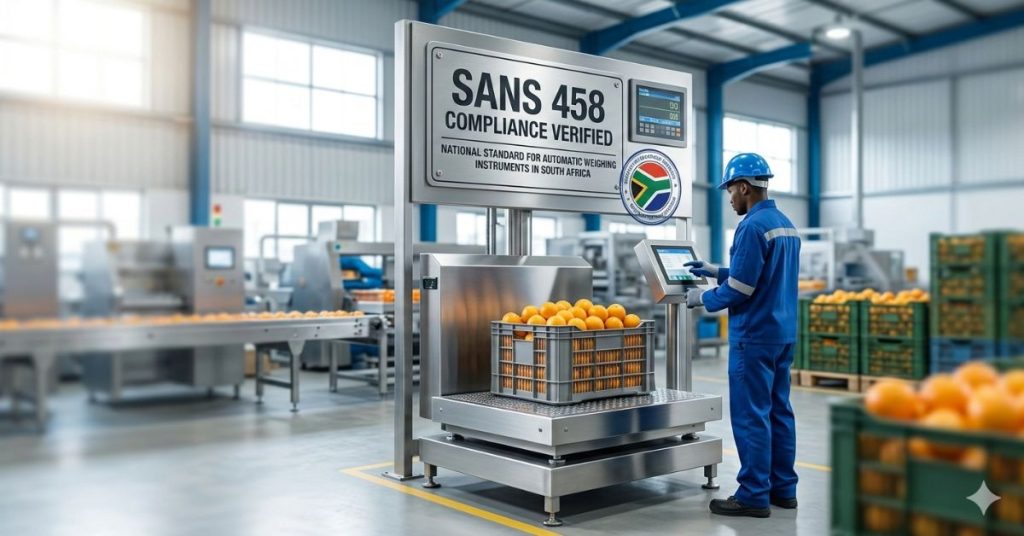
If you’ve ever bought an industrial scale in South Africa, chances are someone mentioned SANS 458 at some point. Maybe it was your supplier, your calibration technician, or a government inspector. And if you’re like most business owners, you probably nodded along without fully understanding what it actually means — or why it matters for your business.
Don’t worry. You’re not alone. SANS 458 is one of those topics that sounds complicated but is actually straightforward once someone explains it properly. That’s exactly what we’re going to do in this article — break it down in plain English so you know exactly what SANS 458 is, whether it applies to your business, and what you need to do about it.
What is SANS 458?
SANS 458 is a South African National Standard that sets out the requirements for non-automatic weighing instruments used in trade. In plain English — it’s the standard that governs whether a scale is legally approved for use in commercial transactions in South Africa.
SANS stands for South African National Standard. These standards are developed by the South African Bureau of Standards (SABS) and cover everything from building materials to food safety to weighing equipment. SANS 458 specifically covers non-automatic weighing instruments — which includes most industrial scales, platform scales, floor scales, bench scales, and retail scales used in commercial environments.
The standard defines requirements for accuracy, construction, performance, and verification of weighing instruments used in trade. A scale that meets SANS 458 requirements can be legally verified and stamped for use in commercial transactions — meaning you can legally use it to buy or sell goods by weight.
What Does “Legal for Trade” Mean?
You may have seen the phrase “legal for trade” when shopping for scales. This refers directly to SANS 458 compliance. A scale that is legal for trade has been tested, verified, and approved to meet the accuracy and performance requirements set out in SANS 458.
Think of it like a speed limit. The speed limit exists to keep everyone safe and ensure a fair, consistent standard on the road. SANS 458 works the same way — it exists to ensure that weighing instruments used in commercial transactions are accurate, consistent, and fair to both buyer and seller.
If you’re selling products by weight — whether that’s meat at a butchery, produce at a market, chemicals at a factory, or scrap metal at a recycling yard — your scale needs to be legal for trade and SANS 458 compliant.
Does SANS 458 Apply to Your Business?
This is the question most business owners want answered first. The short answer is — it depends on how you use your scale.
SANS 458 compliance is required when a scale is used for commercial transactions — that is, when the weight reading is used to determine the price of a product being bought or sold. Examples include butcheries selling meat by the kilogram, produce markets selling vegetables by weight, recycling yards buying scrap metal by the ton, chemical suppliers selling products by weight, and logistics companies charging freight rates based on weight.
SANS 458 compliance is not required when a scale is used purely for internal purposes — such as quality control, inventory management, batch weighing, or production monitoring — where the weight reading does not directly determine the price of a commercial transaction.
If you’re unsure whether SANS 458 applies to your specific operation, the safest approach is to assume it does and seek verification. The consequences of using a non-compliant scale in a commercial transaction are serious — and ignorance is not a valid defence under South African law.
Who Enforces SANS 458 in South Africa?
SANS 458 compliance is enforced by the National Regulator for Compulsory Specifications (NRCS) under the Legal Metrology Act. The NRCS is responsible for ensuring that weighing instruments used in trade across South Africa meet the required standards.
NRCS inspectors conduct routine inspections of businesses that use scales for commercial transactions. If your scale is found to be non-compliant, inaccurate, or unverified during an inspection, you can face fines, the seizure of your scale, and potentially being ordered to stop trading until the issue is resolved.
For businesses in industries like food retail, agriculture, recycling, and logistics — where scales are used daily for commercial transactions — NRCS compliance is not optional. It is a legal requirement.
What is Scale Verification and How Does It Work?
Scale verification is the process of testing a scale against known reference weights to confirm it meets the accuracy requirements of SANS 458. Verification is carried out by an accredited verification officer — typically from an NRCS-approved calibration and verification service.
During verification, the scale is tested at multiple points across its weighing range using certified reference weights. If the scale performs within the accuracy tolerances specified in SANS 458, it is stamped and certified as verified for use in trade. The verification stamp — typically a physical mark or seal applied to the scale — is your proof of compliance.
Verification is not a once-off process. Scales used in trade must be re-verified periodically — typically every one to two years depending on usage and the type of scale. This ensures that scales remain accurate over time and continue to meet SANS 458 requirements throughout their working life.
What Types of Scales Need to Be SANS 458 Compliant?
Any non-automatic weighing instrument used in a commercial transaction in South Africa needs to meet SANS 458 requirements. This includes retail scales used in supermarkets, butcheries, and produce markets. It includes platform scales and floor scales used in warehouses and logistics operations where freight is charged by weight. It includes crane scales and hanging scales used in recycling and agricultural operations where products are bought and sold by weight. It includes bench scales used in food processing and manufacturing operations where product weights determine pricing.
Our range of platform scales, floor scales, crane scales, and hanging scales are all suitable for verification and SANS 458 compliance when used in conjunction with an accredited verification service.
How Do You Get a Scale Verified in South Africa?
Getting a scale verified for SANS 458 compliance in South Africa involves three steps. First, purchase a scale that is suitable for verification — not all scales are designed to meet SANS 458 accuracy requirements, so it’s important to choose a scale that is fit for purpose. Second, contact an NRCS-accredited verification service in your area. They will arrange to test your scale against certified reference weights and issue a verification certificate if it passes. Third, maintain your scale correctly and arrange re-verification when required — typically every one to two years.
It’s important to note that Industrial Scales South Africa supplies weighing scales but does not provide calibration or verification services. We recommend contacting the NRCS directly or searching for an accredited verification service in your area to arrange scale verification.
What’s the Difference Between Calibration and Verification?
This is one of the most common questions we get asked — and it’s an important distinction. Calibration is the process of adjusting a scale to improve its accuracy. It is typically carried out by the scale manufacturer or a calibration technician and does not by itself constitute legal verification for trade purposes. Verification is the formal process of testing a scale against SANS 458 requirements and issuing a legal stamp of compliance. Verification can only be carried out by an NRCS-accredited verification officer.
In practice, calibration often precedes verification — the scale is calibrated to ensure it is as accurate as possible, and then verified to confirm it meets SANS 458 requirements. Both processes are important for maintaining an accurate, compliant scale in a commercial environment.
Frequently Asked Questions About SANS 458
Do all industrial scales need to be SANS 458 compliant?
No. Only scales used in commercial transactions — where the weight reading determines the price of a product being bought or sold — need to be SANS 458 compliant. Scales used purely for internal purposes such as quality control or inventory management do not require SANS 458 verification.
How often does a scale need to be re-verified?
The re-verification period depends on the type of scale and its usage. In most cases, scales used in trade need to be re-verified every one to two years. Your verification officer will advise on the specific re-verification requirements for your scale.
What happens if my scale fails verification?
If your scale fails verification, it cannot legally be used for commercial transactions until the issue is resolved. The scale may need to be recalibrated or repaired before re-verification can be attempted.
Can I buy a pre-verified scale?
Some suppliers offer scales that have been pre-verified before sale. However, verification is location and installation specific — a scale that was verified at the supplier’s premises may need to be re-verified once installed at your premises. Check with your verification officer for guidance.
Where can I find an accredited verification service in South Africa?
Contact the NRCS directly at www.nrcs.org.za for a list of accredited verification services in your area. The NRCS maintains a register of approved verification officers across all nine provinces.
Choosing the Right Scale for Your Business
Whether or not your operation requires SANS 458 verified scales, choosing the right scale for your specific application is critical. The wrong scale — too small a capacity, wrong platform size, or insufficient accuracy — will cause problems regardless of its compliance status.
At Industrial Scales South Africa, we supply a comprehensive range of heavy duty industrial scales suitable for a wide range of commercial and industrial applications across South Africa. Our platform scales are available in capacities from 100kg to 5 Ton. Our floor scales are designed for high-throughput warehouse and logistics environments. Our crane scales and hanging scales cover capacities from 300kg to 5 Ton for suspended load applications. And our agricultural weighing solutions are trusted by farming operations across all nine provinces.
Contact us today on 011 048 2402 or email info@industrialscalessouthafrica.co.za for free advice on choosing the right scale for your business — and we’ll help you find a solution that meets both your operational needs and your compliance requirements.