
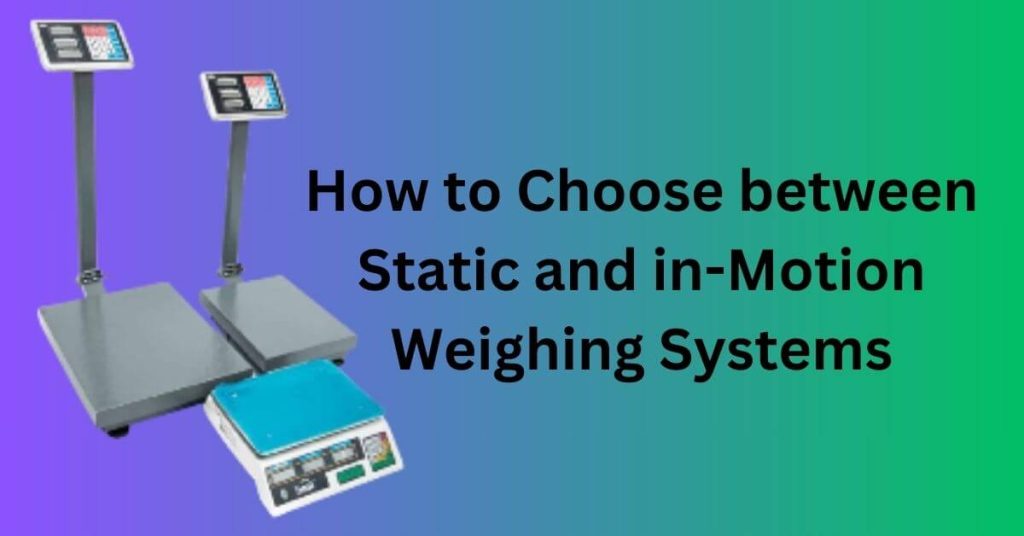
When selecting a weighing system for your business, one critical decision is whether to choose a static weighing system or an in-motion weighing system. These systems serve different operational needs, and understanding their advantages, limitations, and applications is essential for making an informed choice. In this article, we’ll dive deep into each system, comparing their functionality and helping you determine which best suits your business needs.
What is Static Weighing?
Definition:
Static weighing refers to the process where an object must come to a complete stop on a weighing platform or scale before its weight can be measured.
Advantages of Static Weighing
- High Accuracy
Static systems provide precise measurements because the object remains stationary, minimizing the influence of external variables such as movement, vibration, or wind. This makes static weighing ideal for situations where even slight weight deviations are unacceptable. - Cost-Effective
Static weighing systems are generally less expensive to purchase and maintain compared to their in-motion counterparts. This makes them an excellent choice for businesses that prioritize precision but are working within budget constraints. - Simplicity
These systems are straightforward to use, requiring minimal training for operators. Their simplicity reduces the likelihood of user errors during the weighing process, ensuring consistent accuracy.
Limitations of Static Weighing
- Throughput Reduction
A significant drawback of static weighing is that the process requires halting production, which can slow down operations. This can be particularly problematic in high-volume environments where speed is crucial. - Limited Sample Size
With static weighing, typically only a few items can be weighed at a time. This can allow for discrepancies—such as underweight or overweight products—to go unnoticed, especially if items aren’t checked thoroughly.
What is In-Motion Weighing?
Definition:
In-motion weighing involves measuring the weight of objects while they are moving across a scale. This allows for continuous weighing without stopping production.
Advantages of In-Motion Weighing
- Efficiency
In-motion systems offer high throughput, allowing items to be weighed as they move through the production line. This reduces bottlenecks and ensures minimal disruption to the workflow, making it ideal for industries that need to maintain a fast-paced environment. - Comprehensive Data Collection
Unlike static systems, in-motion weighing allows for the weighing of 100% of products. This comprehensive approach reduces the risk of missing outliers or discrepancies that may occur with spot-checking methods in static weighing. - Real-Time Monitoring
In-motion systems provide immediate feedback on weight data, facilitating quick adjustments in production for improved quality control. For businesses that rely on precise weight monitoring for regulatory compliance, this can be an invaluable feature.
Limitations of In-Motion Weighing
- Potential Accuracy Trade-offs
While generally accurate, in-motion systems can experience slight accuracy trade-offs due to the dynamic forces acting on moving objects. Factors such as vibration, speed, or object shape can affect the precision of the reading. - Higher Initial Costs
The investment in in-motion systems tends to be significantly higher than in static systems. This higher initial cost may deter businesses with limited budgets from adopting the technology, though long-term gains in efficiency can offset these costs over time.
Key Factors to Consider When Choosing
1. Industry Requirements
Certain industries, such as food processing or pharmaceuticals, may require precise and continuous weight measurements. In such cases, in-motion weighing systems are often more suitable because they provide a balance of efficiency and real-time data for quality control. On the other hand, industries where precision is more critical than speed—such as laboratories—might lean towards static weighing systems.
2. Production Volume
For businesses with high production volumes, the speed of in-motion systems offers a clear advantage. By allowing the weighing of products on the go, these systems ensure that production is not slowed down by the need to stop and weigh each item individually. However, if your operation handles lower volumes, a static scale may suffice, providing the precision you need without the added cost of an in-motion system.
For high-volume industries, like manufacturing and distribution, in-motion systems can lead to substantial improvements in overall efficiency.
3. Budget Constraints
Budget plays a major role in determining which system to choose. Static scales tend to be more affordable both in terms of initial purchase price and maintenance costs. If you’re working within a tight budget but still need accurate measurements, a static system may be the better option.
However, long-term savings associated with increased operational efficiency from in-motion systems should also be considered. Although the upfront cost is higher, the system’s ability to speed up processes and reduce errors can save money over time, especially in high-volume operations.
4. Accuracy Needs
If accuracy is your top priority—particularly in applications where weights must meet legal standards for trade—static systems are the preferred choice. They eliminate the variable factors that might affect in-motion weighing, providing the most reliable readings for compliance and precision-based industries.
In contrast, for applications where absolute precision is less critical and efficiency is more important, in-motion systems offer a suitable solution. These systems still provide a high degree of accuracy while facilitating faster throughput.
Conclusion: Which System is Right for Your Business?
Ultimately, the decision between static and in-motion weighing systems comes down to your specific operational needs, budget, and the importance of accuracy versus efficiency in your industry.
Choose a Static Weighing System if:
- Your business requires highly accurate measurements and can accommodate slower processes.
- You are working with low to moderate volumes of products.
- Budget constraints are a primary concern.
Choose an In-Motion Weighing System if:
- You need to maximize throughput and ensure minimal disruption to production.
- Your operation involves high-volume processing where continuous weighing is advantageous.
- Real-time data collection and immediate feedback for quality control are important in your workflow.
Visit industrialscalessouthafrica.co.za to explore our range of static and in-motion weighing systems designed to meet the unique needs of your business.
By assessing your specific requirements and weighing the pros and cons of each system, you can make an informed decision that improves both accuracy and efficiency in your operations. Whether you’re in manufacturing, food processing, or logistics, selecting the right weighing system can have a profound impact on your business’s performance and bottom line.
FAQs: Choosing Between Static and In-Motion Weighing Systems
1. What is the difference between static and in-motion weighing?
- Static weighing requires the object to stop completely before its weight is measured.
- In-motion weighing measures the weight of an object while it moves over the scale, without needing to stop production.
2. Which system offers better accuracy?
Static weighing generally provides more precise measurements because external factors, like movement or vibration, are minimized. In-motion systems are accurate, but dynamic forces can affect their precision slightly.
3. When should I choose a static weighing system?
Static systems are ideal when you require high accuracy and are willing to slow down production for precise measurements. They’re also suitable for lower-volume operations or when budget constraints are a factor.
4. What are the advantages of an in-motion weighing system?
In-motion systems allow for continuous weighing, resulting in higher throughput, faster production, and real-time data monitoring. They are best suited for high-volume operations where efficiency is a priority.
5. Are in-motion weighing systems more expensive?
Yes, in-motion weighing systems generally have higher upfront costs compared to static systems. However, the increase in efficiency and potential long-term savings can make them a valuable investment.
6. Can in-motion weighing systems handle 100% of production?
Yes, in-motion systems can weigh all products passing through the production line, offering a comprehensive solution for high-volume industries.
7. What factors should I consider before choosing a system?
Consider your industry’s accuracy needs, production volume, budget, and whether speed or precision is more important for your operation.
8. Are static weighing systems slower?
Yes, because objects must come to a full stop for static weighing, it can slow down production, making it less efficient for high-volume environments.
9. Which industries benefit from in-motion weighing?
Industries such as logistics, manufacturing, and food processing benefit the most from in-motion systems, as they need to maintain high throughput and real-time data monitoring.
10. Where can I purchase static or in-motion weighing systems in South Africa?
You can explore a range of static and in-motion weighing systems at industrialscalessouthafrica.co.za, tailored to fit your business’s unique needs.
These FAQs help address common concerns and provide clarity on which system may be the best fit for your operation.
Related Articles:
- How to choose the right industrial scale for your business in South Africa
- How to compare platform scales vs. floor scales for industrial use
- How to select the best bench scale for small industrial applications
- How to determine if you need a crane scale for your South African industry
- How to decide between digital and analog industrial scales
- How to pick the appropriate capacity for your industrial scale
- How to choose scales for hazardous environments in South African industries
- How to select scales for food processing industries in South Africa
- How to determine if you need a counting scale for inventory management
Contact Us Today!
For more information or to get in touch with us at Industrial Scales South Africa, you can contact us through the following:
- Website: industrialscalessouthafrica.co.za
- Email: info@industrialscalessouthafrica.co.za
- Phone: 011 048 2402
- Address: 77 5th Street, Wynberg, Sandton, 2090, Johannesburg
Feel free to reach out for expert advice or to inquire about our products and services. We’re here to help with all your industrial scale needs!
Remarkable! Іts truly amazing paragraph, I have got mᥙch
clear idea regarding from this paragraph.